Monday, March 19, 2007

Blueprint for tyranny

A lot of "planning" goes on in California.
The latest round of "planning" for San Joaquin County is organized by the San Joaquin Council of Governments (COG) using a $2 million grant from the federal government. The general idea is that they are supposed to use the money to organize a program of "finding out what people want" with regard to "planning."


One should always be a little wary when the government spends a lot of money to "involve" you in some plan, or their plan. If history is any guide, whenever the government funds a plan to gauge public opinion, the answers always seem to be what the government experts wanted in the first place.

Now we are getting a chance to witness this first-hand. The COG is organizing a series of public meetings or "workshops" to, presumably, find out what people "want."

I got to attend one of these workshops in Lathrop.


It starts out with a presentation from the expert about the scary growth. He then suggests that it's up to "us" to determine "what to do about it."

Maybe this was a quirk, but I found it interesting that of all the persons at our table, only ONE (1) was someone who lived in the community. Others were City Councilmen, former city councilmen, planning commissioners, real estate brokers, someone in the building trades. I introduced myself as someone interested in the process, which is the truth, but I didn't live in Lathrop either! The facilitator seemed perfectly happy with the group mix, and even invited me to be sure to come to workshop in Manteca! (The Manteca workshop is Wednesday, Mar 21, at 6:30 pm at the Manteca Public Library -- you should go!)

Next, after breaking up into small groups led by a COG "facilitator" we get the chance to express "what we want." We're presented with seven areas of interest, and have to pick the five most important. For example, things like "housing" or "water" or "transportation." This, presumably, tells us what we think is important.

However, note that what we are really choosing is which of the five topics presented by them is most important. This is different than what the people think is important. For example, no where on that list of "things you think are most important" did anything like "freedom" or "property rights" or "abuse of eminent domain" or "abuse of redevelopment" appear. Those, apparently, aren't options the people are allowed to think about or choose.

After choosing the five "most important" issues (as determined by them), next we were to choose what to do about them.

The way this exercise worked is that everyone is given a stack of colored cards, about the size of playing cards. For each of the issues that they, I mean we, determined were important, you then have to pick one of four cards, indicating "what you want to do about it."

For example, lets say the topic is "water." You have to pick one of the four pre-selected options for how to deal with the "water problems." And here's the interesting thing. The cards have bar graphs on them indicating how much governmental interference you would prefer. They are ranked one to four, with one being the least regulation and four being the most regulation. The cards were also coded with playing card suits, that is, clubs, diamond, spade and hearts. Although the reason for the suits is unclear.

One person was a little confused by the process. I half-jokingly suggested that the four cards represent "the Republican, Democrat, Green Party and the Communist Workers' Party, take your pick."

This is the point -- in every case, the "lowest level of regulation" was the current level of regulation. And it went up from there. Level 2 was "a little more regulation," level 3 was "a moderate amount of regulation," and if you picked the fourth card, you were choosing "heavy regulation." So, I ask, where is the choice for less regulation? What kind of answer do you expect to get when the lowest level you can choose is the current regulations? Where is the voice of those who want less regulation?

Maybe that's sacrilege to them. The possibility that someone would blame the current regulation for some of our problems apparently either never occurred to any of the government facilitators or, that's just not an answer they want to hear.

Overall, our groups seemed to center around "level 3." You can tell this because the selected cards are handed in and put on a board, they form what looks like a bar graph on the board. Given the limited choices and various other ways that each option was presented (I haven't gone into details here) that is what we are being told that we want. It is interesting that that process doesn't just involve getting input from the public. Information was going both ways, we were not only being told what we want, but also being told "see, this what all your neighbors want too!"

So quit arguing!

Friday, March 09, 2007

Thursday, February 08, 2007

Manteca approves development scheme

Left: Developers, lawyers and EDAW people seem happy their project has been approved.

If you ever need a lesson in why housing costs so much, look no further than the Environmental Impact Report prepared for this project.

The Oleander, Sundance, Sundance 2 project is a plan to build houses and "develop" a 230 acre area just south of Manteca. The plan is to build 1,074 new houses, to set aside some land for "commercial development" and to construct various parks, including a promised new Boys' and Girls' Club. The experts estimate that about 3,341 people will live in the project, increasing Manteca's population by about 6.8 percent.

The Environmental Impact Report is required by a California law passed in the 1970s. The intention of the law is to, I guess, minimize damage or "impacts" to the environment. Or, lacking that, at least notify everyone about the "impacts."

By the way, did you notice that term, "impact?" Why is nothing ever just an "effect" or a "result," but rather, an "impact." To "impact" something is to hit it or strike it -- it conjures up the mental image of something slamming into an object, causing destruction. E.g. "The impact of the meteor ...." But I digress again.

The way the EIR is organized, it attempts to list or identify all the "environmental effects" (or impacts), then recommends or mandates mitigations or things that can be done to reduce these effects or make them less damaging to the environment.

I put the word in quotes there on purpose because, as you'd see if you ever read one of these reports, a lot of the effects of the project are anything but "environmental." Instead, most of the report talks about how they will need more of your tax money for the schools, the roads, the sewage treatment plant, a new water tank, etc. In addition, the EIR spends a lot of time on what I call "meddling." These are things that are someone's idea of what a housing project should look like, for example, the size of the garages on the houses, the requirement for gabled roofs, the requirement for walking trails and "neighborhood centers," etc, etc. etc. What do these things really have to do with "the environment?" Much of the EIR reads like a document from the Central Planning department of the old Soviet Union.

Now, you might get the idea I don't like the idea, or don't like "development." No, you won't hear any silly complaints from me. Things like "all these new people are moving in" and how Manteca isn't the small town we love, how we are losing the "character" of the town or something, how we are losing all this "great farmland," etc, and how terrible this is. I don't get into that. In fact, I'm all for the building of new houses. People need a place to live. The only way to create affordable housing is to build houses.

And that's where the problem is. The real purpose of this years-long process of study, preparation and publishing an EIR seems to just make it harder to build a house. And, perversely, prevents competition from other house builders. That makes whoever can get through the process and finally get permission to build and sell houses very happy. And leaves everyone else to either pay their price or not have a house. It's sort of a win/win so long as you don't count the people who would like to have a house.

Maybe some examples from the EIR itself will help show what I'm talking about:

1. The report says if they find any burrowing owls during construction, they have to stay 75 meters away from the nest until a "qualified biologist" determines that the fledglings can forage on their own. Whatever that's supposed to help, I don't know. But the fun part is that they permit the construction workers to blast the field with chemicals to poison the ground squirrels, the owl's favorite food! "To discourage the owls... by discouraging the presence of the ground squirrels..."

Maybe they skipped biology 101: When you poison the prey, you poison the predator. The field of perhaps 230 acres will be covered in dead or dying poisoned squirrels, the food for the owl we are trying to "protect." What kind of mitigation is this?

2. The area is a "likely," and I'll paraphrase a bit, Indian burial ground. As a fix or "mitigation," they are going to bring out a state-certified archaeologist and an American Indian medicine man who will perform some unspecified procedure. See pg 4.4-12 in the EIR if you think I'm making this up. I sure hope it works! Don't they watch those movies?

3. A drainage ditch a few feet long, dug on one of the farms, has been declared "a waterway of the United States" and they have to fence it off, bring in the Army Corps of Engineers, and apply for a bunch of permits before they fill it in. In the end, they are just going to fill it in anyway. So why bother with the fences and the Army?

4. This is my favorite -- They determined that State Road 120, which runs just north of the project, spews out something they call "toxic air contaminants" (TACs). There's nothing they can do about that, but it's the suggested fixes that get me.

First, they say to put the Boys' and Girls' Club 500 ft. from the roadway to lessen the exposure to "sensitive receptors," otherwise known as boys and girls.

Next, they suggest putting the high density housing (read: poor people) next to the highway, the area with the toxic air! That way the wealthy home buyers can enjoy the cleaner air. What a plan! Sure, they don't put it quite those words. The reason given talks about how this is because the poor have "greater turnover" and so because the poor people in the apartments won't stay there as long as the wealthy homeowners, their overall exposure to the toxins will be less. (EIR, pg 4.3-23). Along the same lines, they suggest a wall and planting a row of trees. To stop the toxins from the highway?

I wonder if they are going to be handing out a notice to the renters that says something like "the air here is highly toxic, but we don't expect you to stay here too long, so I'm sure you'll be fine."

Tuesday, January 02, 2007

Developers: Don't let any competitors build houses!

Notes on council comments, 18 Dec 06:

Introduction:

In Manteca, a "Community Revised Growth Management Program" (CRGMP) restricts the number of new houses that can be built to about 3.9 percent each year. The stated purpose is to "help" the community, preserve the "small town culture" and control or limit traffic "congestion" and other high-minded principles. However, as Milton Friedman explained years ago, you shouldn't judge a government program by its intentions, but by its actual effects. The actual effect of the CRGMP, or "growth cap" is to limit the number of houses that can be built. This serves two main purposes: First, the city wants to get large sums of money for the permits to build each house. (The mayor made these comments a few yeas ago, he said "we're in the driver's seat" and we can demand almost anything from developers, they want to build so badly.) A secondary benefit, for the developers is that limiting the number of houses that can be built helps them demand higher sale prices for their houses. This would help explain why the developers tend to complain a little, but generally go along with the "growth cap" scheme.

The problem with these two effects is that they, as with almost any interference with the free market, the law creates winners and losers. The newspapers and press tout the rising home prices as nothing but a good thing, for the most part. The same is true of the city officials. But there is another side to the issue. For every developer that is able to command a higher than market price for their houses, there is a loser, the individual who wishes to purchase a house at a lower price.

The city even gives lip service to the goal of providing "affordable housing" and has created and proposed programs that cost the taxpayers millions of dollars with the stated goal of providing low cost housing. These "affordable housing" programs are in direct conflict with the "growth cap" policies. One arm of the city attempts to lower the cost of housing, and the other attempts to raise the cost of housing. All at taxpayer expense!

Last month, one of the city's prominent developers asked to have their permits to build houses extended. The spokesman talked about "delays" and "paperwork" first, but then added, almost as an aside, that the market has taken a downturn. He talked about how, darn it, those papers sat on someone's desk for months and we just never got to build the houses in the two years the permit is valid. But I submit that it is the market conditions that is really the issue. Papers don't sit on desks gathering dust when there's millions of dollars to be made. But when the market turns down, as it always does at some point, then perhaps papers can sit on desks gathering dust. In other words, the delay was not primarily caused by paperwork. The delay was deliberate and an attempt to hold off building houses when the price wasn't high enough, and to wait until prices became higher.

This is, of course, a decision the developer is free to make. It's a gamble. The developer knows how much time is left on the permits and he can makes a judgment to build or not build houses. The same is true when a developer requests the permits. They are extremely costly to obtain and the developer has to make a business judgment. Will the cost of the permits be "worth it" considering the current price of houses and the future risk?

When the housing market (bubble) was booming, developers were falling over each other to obtain those permits. There was so much money to be made, they competed with each other with more and more elaborate housing plans, larger houses, more ornate "amenities" being promised; all in the hope of beating a competitor and obtaining the coveted permits. Other smaller or lower cost builders were out competed for the permits.

The developers who made such grand promises to the city in return for the rare and coveted "allocations" were making a decision. Like all business decisions, there are benefits and risks to consider. There's never a guarantee that any business venture will be profitable. When the developer entered into the agreement with the city, they knew the permit cost a certain amount. It was valid for two years. They had to consider the possible amount of profit that could be made, and had to consider the risk of what would happen if housing prices dropped. There was never any agreement to "fix" things and go back and re-negotiate if the market didn't go their way!

You could think of it just like buying or selling anything else. The stock buyer doesn't know for sure the price of the stock will go up. It might go down. But the buyer makes his best judgment. If he guesses right, he makes lots of money. But what if he guesses wrong? Should the government or city council tell the buyer, "we'll fix market" to make it right for you? In the case of houses, there are two sides, the developer (seller) and the buyer. If the city steps in to try to "help" the sellers, they end up hurting the buyers who want to buy houses at lower prices.

The lower housing prices are good for some, bad for others. The city should not be taking a position that favors one side of the economic equation (the house sellers) and harm the other side (the house buyers). Why would one group deserve favor and the other group deserve to be harmed?

The talk at the Council meeting was about how they want to "stimulate" the market. This is confusing talk. Nothing could be further from the truth. They mentioned how important it was to "keep the builder working!" But the effect of the policy is to reduce, not increase, the amount of construction! They are reducing the number of building permits available. That does not help the builder to build more, it prevents the builder from building. The one it "helps" is anyone who owns the development firm and doesn't want any competitors to get permits. That is not "stimulating" anything. The home buyers also will be spending more money on their home instead of spending it on any other business in Manteca. In a way, trying to "support" the price of houses hurts a lot of people, not just those who wish to buy a house, it hurts every business because their customers must now pay more for their houses instead of something else.

The new proposal:

The plan is complicated, but I'll try to simplify it. The plan is to "extend" all the current permits by an additional year. This helps the holders of the permits because what they can do is "hold" the permits for another year and hope that the prices of houses goes back up, then they can possibly build houses when the price is better for them. The drawback of this is that there will be no permits available for any others who want to build houses. There may be lower cost developers who want to build, and would be willing to apply for the permits. Competitors may be able to get the permits at less cost, and not need to promise as many "amenities," etc. Also, they may see an opportunity to build and sell lower priced houses. They may, correctly, decide there's pent up demand on the lower end of the financial scale, and this presents an opportunity for selling lower cost housing. This would provide "affordable" housing at no taxpayer expense!

But the current permit holders don't want that. They want to "hold" all the permits. By holding the permits, they are, in effect, stopping every competitor from building houses at lower cost! This is not good for the people of Manteca. Many people need housing! There are many who would love to buy a house at lower cost. But the city, in attempting to be "nice" to one group, the developers, and give them "help" will end up hurting those who want an affordable home.

The plan also includes adding a few hundred allocations. The justification is silly. The argument given is that the new police headquarters is allocated 60,000 gallons per day, but will probably only use 6000 gpd. So, then that leaves 54,000 gpd "available." But there are other buildings around town, like department stores and things like that, that use a fraction of what the city rules estimated. There are millions of gpd "available" if that is the standard. It appears that the city planner simply picked a figure of 54,000 gpd so that it would permit about 250 new housing permits.

In other words, the bottom line of the plan is to let the developers hold their expiring permits, leaving none available this year. So, instead of having 890 permits available this year, the new plan will hand out about 250 "extra" permits. But whatever they are called, instead of giving out 890 permits, they will give out 250. This is an obvious attempt to raise the price of housing by making it scarce or harder to build a house! It's an attempt to "fix" what they see as a "problem," namely, houses becoming affordable.

For the first time, the city staff actually acknowledged this. For years, they have been saying the reason for the housing permits is for those previously mentioned reasons, to "control growth" for "the good of the everyone." In the meeting, the assistant city manager (McLaughlin) talked about "the price of housing" and how the goal is "to try to stimulate the ... uh... economic" something. What she was saying, or trying to avoid saying was that the goal is to limit the number of permits available, in the hope that this will make housing more expensive, and in turn, make the developers happy, regardless of how this may be bad for everyone who's not a developer.

Which finally leads to my objection to the whole thing. The city government should not be hurting the people who need affordable housing, in order to grant favor to politically well connected developers. The people shouldn't have to pay extra taxes to help "provide" affordable housing at the same time the city is creating the shortage of affordable housing!

Last, to add insult to injury, there is talk that the much touted fire station may not be built. The reason is that the developer promised to help build the fire station, and if he doesn't get this special favor, he won't build the fire station as he promised. The city just passed a controversial sales tax increase, Measure M, and promised the voters if they approve it, there will be a new fire station by July! By July! And now, we are being told that "the fire station will be built on schedule, but, oh, the schedule has been changed, now it may not be until ... get this... 2014. The year 2014! Incredible!

In fact, at the previous City Council meeting, when the issue was first raised, the Fire Chief of Manteca gave a presentation. Why the fire chief was talking on behalf of the developer is anyone's guess, I didn't ask that question. He showed maps of how needed this fire station was, and urged us and the City Council to "give the developers what they want... we really need this fire station! Live are at stake!" But the people of Manteca had just voted for Measure M, raising the sales tax to 8.25 percent and were promised the fire station if they voted for it! This is an outrageous betrayal of the public trust.

As a side note, if you look at those maps the Fire Chief provided (I'll have to scan those in) you can see that only a small portion of the "3000 homes" outside the 5 minute response time will be helped by the addition of this new fire station. Only houses in the northwest section of the city are helped by the new fire station. There are huge new developments in the southwest and southeast of the city that will go "without" even with the new fire station, as well as a neighborhood in the northeast. This wasn't mentioned when the city leaders promised that the measure M tax increase was "needed." They mentioned how there were 3000 or 2000 houses far from a fire station, but they didn't mention that even with the new fire station, there still will be thousands of houses that won't be helped at all by one fire station in Northwestern Manteca. (Yes, thousands. They are still building in those other areas, meaning there will still be thousands of houses outside the 5 min. response time even if or when the new station is built) (That figure of 2000 or 3000 houses is also in dispute. That's a subject for another article. The last count was really1,979 homes outside the 5 minute range. But I digress)

Along the same lines, the city backed "citizen group" that campaigned for Measure M repeatedly said "We have the money to build the fire station, we just can't afford to staff it!" They repeated that many times. Yet no city official corrected that. (The city disputed things I said about Measure M, even though it turns out I was right, but that's another story). After promising the new fire station, now we find out that it "depends" on giving special favor to some developers!

OK, one more point. The developers were big contributors to City Council candidates, and, maybe most importantly, all of the largest developers gave cash to the "Measure M" campaign group. Why would developers want to give money to raise the sales tax? Raising the sales tax doesn't help you sell houses. People are slightly less inclined to buy a house in a town that has a high sales tax verses a town with lower sales taxes! So why were the developers giving thousands of dollars to get Measure M passed? Could it be they are now getting their payback in the form of special privileges? They get to hold their permits and stop competitors from building houses for the next year. It's brilliant.

Sunday, November 26, 2006

Redevelopment money to remove poor people:

Poor people say "Thank you for removing me."

That's what's likely to happen. If I were these people, I'd be a little nervous.

I find the comments from the people in the mobile home park to be incongruous and hard to explain. If I offend, I'm sorry, but this has to be said: People -- Don't you realize the city is trying to throw you out of your homes?

The city spends "redevelopment" money on an area to "spruce it up" because the city is trying to make the land more valuable. The increased property values, in theory, are supposed to cause property taxes to increase, paying back the redevelopment loans (bonds) . Yes, it's a crazy way to fund something, but that's another story.

There's a plus side and a minus side to increasing property values. It's great if you are one of the ones who owns property there. It may increase in value, giving you a windfall. On the other side of the coin, if you rent a space in a pre-fab home park, you could see either one of two things:

  • Either your rent will skyrocket
  • Or, the whole place will be sold to some commercial interest and you'll be just told to leave.


Notice I didn't say "that might occur" if the property values rise. I said it will occur because that is what must occur because of economics.

It's hard to make the argument that it would be better if we left the place "run down." That sounds like the argument I'm making. I don't know the answer to that. But the point is that the Moffat Boulevard redecorations serve someone's interest. The city's, big developers, commercial interests, real estate agents, and others. Bascially everyone except the people living in the mobile homes interviewed for The Record article! If I were one of those people, I'd want it left just as it is. A sidewalk might be nice, but if it means being thrown out of my home... I think I'd rather deal with some puddles on the road than either have the rent doubled or tripled or be homeless entirely.

There's also something odd in the statements about the actual usefulness of the "sidewalks." It can't possibly be to reduce the traffic hazard. The Tidewater Bikeway runs right along the railroad tracks on Moffat. You don't have to be on a bicycle to use the bike trail, you can walk or roll in a wheelchair, jog or whatever. If there's one place in Manteca that actually doesn't need a sidewalk (for utility reasons) it's Moffat Blvd. They already have the world's best walkway there. All the talk about having to walk by the side of the road and the hazards is just nonsense, why people would make those comments is hard to explain. The bike trail is right there in front of that mobile home park. It couldn't be any closer. So I don't get it.

Why isn't ordinary tax money being used for these "improvements?" Why is it necessary to borrow money? There's something odd going on. And what is also odd is that here, the redevelopment money is being used to reduce so-called "affordable housing." It's a great example, in a perverse sort of way, of how government works against itself. The redevelopment money is supposed to be used to increase "affordable" housing, and here, the same program is being used to decrease "affordable" housing.

Except that the people being thrown out of their homes don't know it yet. And they seem to be thanking the city for finally, after all these years, coming in and making it impossible for them to continue to live there. It's like they are saying "it's about time the city did something to make the place too expensive for me to live!" Unbelievable.

The best case scenario is that the redecorations will do nothing, and just be a big waste of redevelopment money. That would be the best case for the poor people in the mobile home park. Because if the area does "take off" with commercial development, well, pack your bags. Just ask the people in that little mobile home park on Main Street near Sutter. If you can that is, they may be gone already.

Notes from the cutting edge of democracy.

Here are my notes from Election Day (finally):

The day starts early, before 0600 and ends about 15 hours later. If you are lucky.

When we arrived in the morning, we found the electronic voting machines had been stored overnight at the church. (This does sort of contradict the warning not to ever let the machines out of our sight because a "hacker" can spoil the election if he can get to just one machine to insert the "bad code.") We set them up and started them up. Most of them booted up. The hardest part is that "printer" add on. That thing is the flimsiest hunk of plastic ever. It looks like if it were used every day it would last a week. One of the printers didn't work over in the other precinct we were sharing the room with. More about that later.

The training class we attended (prior to election day) was almost fully occupied by instruction and practice in booting up and feeding paper into the electronic voting machines. Very little about the actual process of voting or how to safeguard the integrity of the process.
Note the following from the California Constitution:

CALIFORNIA CONSTITUTION
ARTICLE 2 VOTING, INITIATIVE AND REFERENDUM, AND
RECALL

SEC. 7. Voting shall be secret.


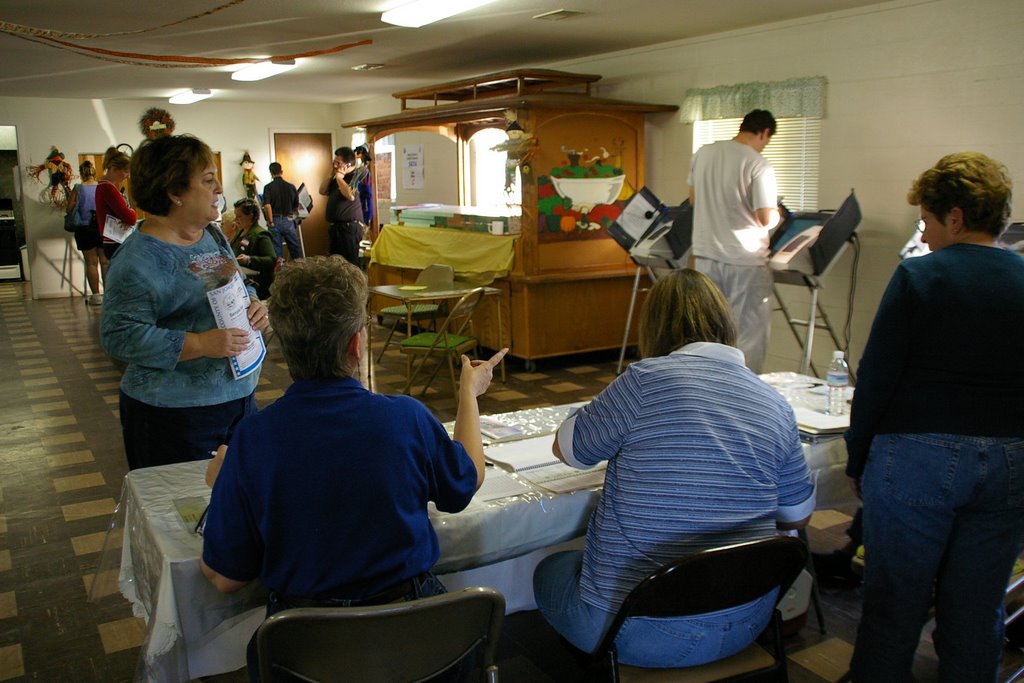
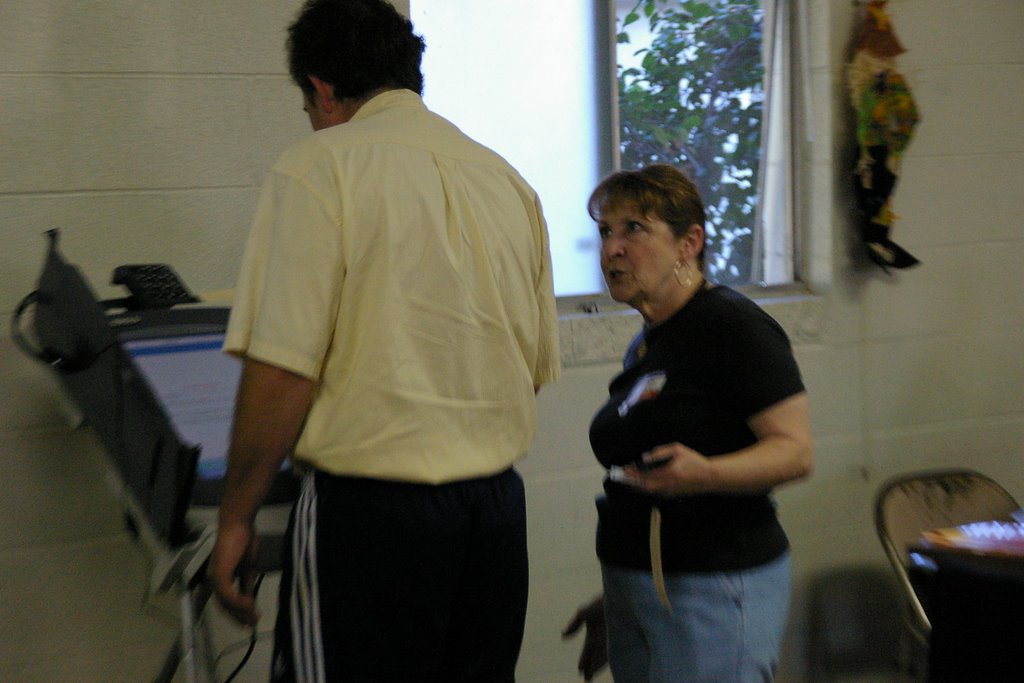
Photo at right shows the polling place on Election Day. Note the con-spicuous non-secret nature of the voting process.


It was like voting on a public stage!

There were also pressure groups "hanging around" almost all day. For example, there were firemen in uniform there, and there was a group that called itself the "labor alliance" I think there. The labor union people were passing out donuts and sort of loudly proclaiming they were there. Sort of keeping an eye on things. Making sure you vote the right way? Who knows.


The voting officials were also hanging around "helping" people vote. Now, I trust them, but how can we say if everyone "trusts" them? The important thing is do you feel your vote is secret, not just if it is or not. Particularly if you are voting against a popular measure or for an unpopular candidate?

These darn electronic machines are an abomination to the voting process. Not only was your vote completely "non-secret" with interested groups looking over your shoulder, but there were also long delays. It took "forever" (about 5 minutes or so on average) to vote the extraordinarily long ballot.

At one point, we were instructed to give up on the machines and accept paper ballots and put them in a specially marked envelope. Except that there were no paper ballots available, so we had people cut the sample ballots out of the sample ballot booklet and submit that as their vote. Ugh!

"The printout is just ... fluff"

If you find assurance in the "voter verified paper trail," take note of what the field inspector told me. We were checking how much paper was left in the machines toward the end of the day. She said "all we care about is the computer chips. Just submit those chips at the end of the day. Do the best you can. Don't worry about the printouts, the paper is .... just ...(she searched for the word)... I don't know if anyone ever looks at them, they are just tossed." She added, "Yeah, they are just fluff." She said something about how they were put there to give the voter a better feeling about the voting machines, but they don't actually have any purpose.

Unfortunately, I don't think she was exaggerating. There are published reports that suggest that the paper rolls are meaningless. Not only is it prohibitively impractical to even attempt to decipher the paper rolls, but also, there's no authority in the law that tells us what to do if the paper disagrees with the computer memory chip! Think about that, if there's no authority to re-count anything with the paper votes, why bother with it? It's just the illusion of security!

There was one machine with a balky printer over in the other precinct (there were three precincts in the room shown) and it didn't bother anyone to vote on the machine even though the paper printer wasn't working right. The computer chip is all that counts!

There were some nice parts of the day. The polls workers are all pretty interesting people. And our "inspector" brought enough food and coffee to set up a buffet. Including fresh fruits, pineapples, finger sandwiches and a cheese ball. And then there was that ride over to deliver the memory card ballots. The commentary from the inspector was pretty amusing, but probably not suitable for print. hehe.

Wednesday, November 22, 2006

Milton Friedman on government, freedom and doing good.

In case you don't have ten hours to spare watching Free to Choose, here is the 30 minute version. This is a fascinating discussion where Milton Friedman explains the basics of what it means to be free and what dangers we are facing in the future.

Click here to view Milton Friedman on google video.